Nvidia Unveils Vera Rubin Platform at GTC 2026 — Six Chips, $1 Trillion Backlog
Nvidia announced its next-generation Vera Rubin AI platform with six new chips, a 10x inference cost reduction over Blackwell, and a $1 trillion revenue outlook through 2027. AWS and Microsoft are already deploying.
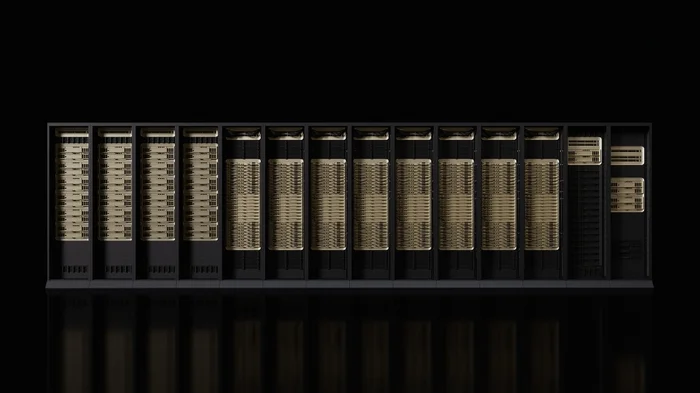
Nvidia used GTC 2026 to announce the Vera Rubin platform, a full-stack computing system built for the agentic AI era. Six new chips. Five rack-scale systems. One supercomputer. And a revenue projection that makes the numbers feel almost abstract: Jensen Huang said he now sees at least $1 trillion in revenue from 2025 through 2027.
The hardware
The Rubin GPU features a third-generation Transformer Engine delivering 50 petaflops of NVFP4 compute. The Vera CPU brings 88 custom Olympus cores designed specifically for agentic reasoning workloads. NVLink 6 provides 3.6TB/s of bandwidth per GPU. BlueField-4 DPU powers AI-native storage infrastructure. ConnectX-9 SuperNIC and Spectrum-6 Ethernet Switch round out the networking stack.
The headline number: a 10x reduction in inference token cost compared to Blackwell. That means running the same AI workloads at one-tenth the cost, or running 10x the workload for the same budget. For companies spending millions on inference, this changes the economics fundamentally.
Training gets a boost too — Nvidia claims 4x fewer GPUs are needed to train mixture-of-experts models on Vera Rubin versus Blackwell.
Who’s buying
AWS committed to deploying more than 1 million Nvidia GPUs across global regions this year, spanning both Blackwell and Rubin architectures. Microsoft Azure became the first hyperscale cloud to power up Vera Rubin NVL72 systems, with 72 GPUs per rack delivering 260TB/s of bandwidth.
The $1 trillion revenue outlook is backed by what Huang described as an “extraordinary” backlog combining Blackwell and Rubin orders. Full production started January 5, 2026, with cloud and system partner deployments expected in the second half of this year.
NemoClaw and the agent stack
Beyond hardware, Nvidia launched NemoClaw — an open-source enterprise software stack combining policy enforcement, network guardrails, and privacy routing for secure AI agent deployment. It pairs with DGX Spark and DGX Station workstations for developing and deploying autonomous, long-running agents within enterprises.
This is Nvidia’s play for the software layer. Selling GPUs is enormously profitable, but selling the entire stack — hardware, networking, and the software that orchestrates AI agents — locks customers into the Nvidia ecosystem more deeply than hardware alone.
Space-1
The most eye-catching announcement: Nvidia confirmed that Space-1 Vera Rubin is being designed to put AI data centers in orbit. The pitch is extending accelerated computing beyond Earth for applications that need low-latency inference in space — satellite constellations, Earth observation, and eventually autonomous spacecraft systems.
What it means
Nvidia’s position is nearly unassailable in the near term. The Vera Rubin platform maintains architectural compatibility with Blackwell while delivering a generational leap in efficiency. The $1 trillion outlook suggests demand isn’t softening — it’s accelerating. The only real constraint is power: running these systems at scale requires gigawatts of clean energy, and the supply chain for that is still catching up.