Meta Open-Sources TRIBE v2: A Brain Encoding Model That Predicts fMRI Responses at 70x Scale
Meta's FAIR team released TRIBE v2, a trimodal foundation model trained on 451 hours of fMRI data from 720 subjects. It predicts neural activity across 70,000 individual brain voxels — a 70x jump over the original — and supports zero-shot generalization to new subjects.
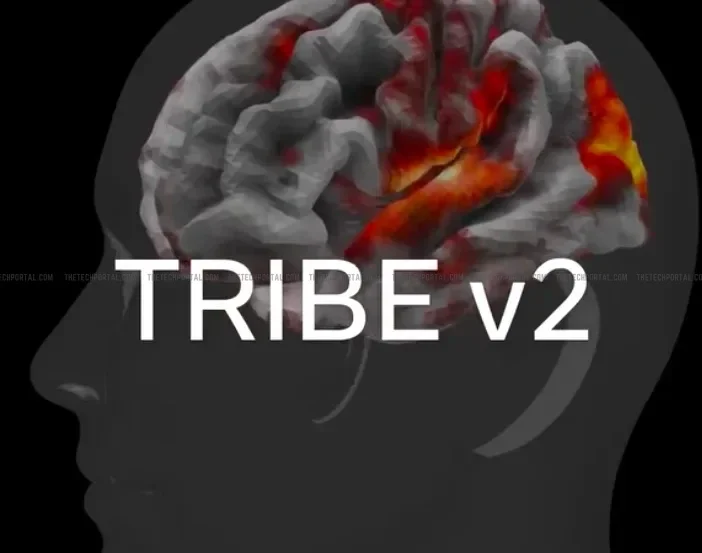
Meta’s FAIR team released TRIBE v2 this week — an open-source foundation model that bridges AI and neuroscience by predicting how individual human brains respond to video, audio, and text. The scale jump from version 1 is not incremental.
The original TRIBE operated on roughly 1,000 coarse brain parcels. TRIBE v2 predicts neural activity at the level of approximately 70,000 individual brain voxels — a 70x increase in spatial resolution. It’s the difference between knowing “this region of the brain activated” and knowing “these specific neurons, in this specific pattern, at this specific moment.”
Training data and architecture
TRIBE v2 was trained on 451.6 hours of fMRI recordings from 25 subjects across four naturalistic studies involving movies, podcasts, and silent videos. It was evaluated on a broader dataset totaling 1,117.7 hours from 720 subjects.
The architecture processes all three modalities — video, audio, and text — through a three-stage pipeline: encoding (modality-specific encoders), integration (cross-modal fusion), and brain mapping (predicting voxel-level fMRI responses). Crucially, TRIBE v2 supports zero-shot predictions: it can estimate how a new subject’s brain would respond to new stimuli without requiring that person to undergo any fMRI scanning.
The model follows a log-linear scaling law — accuracy increases steadily as more fMRI training data is added, with no performance plateau yet observed. That’s a significant finding. It suggests the model hasn’t hit a ceiling, and more data will continue to improve predictions.
What it can do
TRIBE v2 can replicate decades of empirical neuroscience research through digital simulation alone. It correctly identifies specialized brain areas — the fusiform face area, Broca’s area — purely through in-silico experimentation, without running a single new scan. Researchers can now test hypotheses about brain responses to novel stimuli in seconds of compute instead of months of subject recruitment and scanning.
The zero-shot capability is particularly notable. Most brain encoding models require new fMRI data for each new subject. TRIBE v2 can generalize across subjects, languages, and tasks — including conditions never seen during training.
The open-source angle
Meta publishing this as open source means every research lab with a GPU cluster can build on it immediately. What AlphaFold did for protein structure prediction — compressing years of wet-lab work into compute — TRIBE v2 could do for cognitive neuroscience.
It also means that Meta, a company whose business runs on understanding how people respond to content, now has an open model that predicts brain responses to media at voxel-level resolution. The research applications are clear. The commercial implications are left as an exercise for the reader.
Related reading
- AI Models Meta's Muse Spark API Is Still Missing — Two Delays In and No Launch Date
- AI Models MiniMax M3: Open-Weight Frontier Model With 1M-Token Context Beats GPT-5.5 on Coding at a Fraction of the Cost
- AI Models NVIDIA Launches Cosmos 3 — The First Open Omnimodel for Physical AI Robotics and Autonomous Systems