NVIDIA Open-Sources Ising — The First AI Models Built Specifically for Quantum Computing
NVIDIA's Ising is an open-weight family of AI models for quantum processor calibration and error correction decoding. The 35B calibration model outperforms GPT-5.4 on QCalEval, and the decoding model runs 2.5x faster with 3x better accuracy than classical methods.
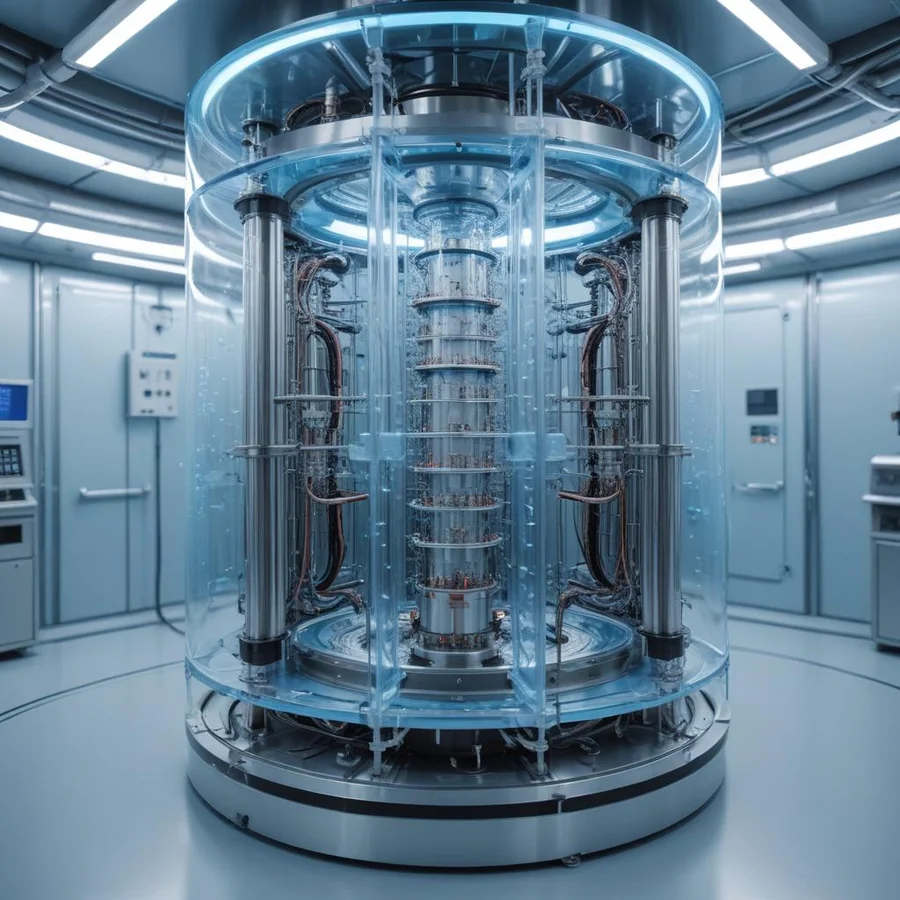
NVIDIA released Ising on April 14 — a family of open-weight AI models designed exclusively for quantum computing workloads. Specifically: quantum processor calibration and quantum error correction decoding, the two tasks that have historically bottlenecked progress toward fault-tolerant quantum systems. Quantum stocks moved sharply on the news.
Why this matters
Quantum processors degrade. Qubits drift, coupling parameters shift, and calibration has to happen continuously — often daily — to keep a processor inside operating tolerances. Current calibration workflows rely on classical heuristics written by hand, tuned per device, and difficult to scale across hundreds or thousands of qubits. Similarly, quantum error correction requires decoding syndromes in real time to detect and correct errors without measuring — and collapsing — the quantum state.
Both problems are effectively learned optimization tasks. NVIDIA is betting they’re AI problems.
Ising Calibration: 35B VLM for qubit data
The first component is a 35-billion parameter vision-language model trained on multi-modality qubit data, including frequency spectra, gate fidelity surfaces, and control pulse waveforms. It supports agentic calibration automation — fed raw characterization data, it proposes parameter adjustments, evaluates them, and iterates.
On QCalEval, NVIDIA’s benchmark for quantum calibration tasks, Ising Calibration outperforms Gemini 3.1 Pro, Claude Opus 4.6, and GPT-5.4. No prior publicly available model was trained on this domain at anything close to this scale.
Ising Decoding: real-time error correction
The second component is a 3D CNN-based framework for quantum error correction decoding. It runs 2.5x faster and is 3x more accurate than traditional algorithmic decoding approaches on standard surface code benchmarks. Deployment support includes FP8 quantization for inference efficiency and integration with CUDA-Q QEC, NVIDIA’s quantum error correction toolkit.
Open weights, open data
Both models ship with full weights, training datasets, and benchmark suites publicly available. This is an unusual degree of openness for NVIDIA — the company typically keeps model internals proprietary. The decision positions Ising as infrastructure-layer tooling for the quantum research community rather than a commercial product.
Who’s using it
Early adopters include Fermi National Accelerator Laboratory, Harvard John A. Paulson School of Engineering, Infleqtion, IQM Quantum Computers, Lawrence Berkeley National Laboratory’s Advanced Quantum Testbed, Academia Sinica, and the UK National Physical Laboratory. The institutions span North America, Europe, and Asia — a sign that NVIDIA is explicitly positioning Ising as a global research standard.
The bigger picture
NVIDIA’s angle here is clear: every quantum processor that ships eventually needs a GPU to calibrate and control it. Ising builds NVIDIA into that workflow at the software layer before the hardware market matures. It’s the same playbook as CUDA — make the programming model indispensable, then collect on the hardware side.
Whether today’s quantum hardware can deliver on fault-tolerant computing before the decade is out remains genuinely uncertain. What Ising does is make the path there slightly shorter and NVIDIA’s role in it considerably harder to remove.
Related reading
- Open Source GLM-5.2: Open-Weight Model Beats GPT-5.5 on Coding at One-Sixth the Cost
- Open Source Meta's Next Two AI Models Are Codenamed Avocado and Mango — Both Will Have Open-Source Versions
- Cloud & Infrastructure NVIDIA Donates GPU DRA Driver to CNCF and Commits $3.8M in Cloud Compute — Kubernetes Is Now AI's Control Plane