Mistral Ships Robostral Navigate: An 8B Model That Steers Robots With One Cheap Camera
Mistral's first robotics model navigates unfamiliar buildings using a single RGB camera and a plain-language instruction — no lidar, no depth sensor, no pre-built map. It beats multi-sensor systems on the R2R-CE benchmark despite using a fraction of the hardware.
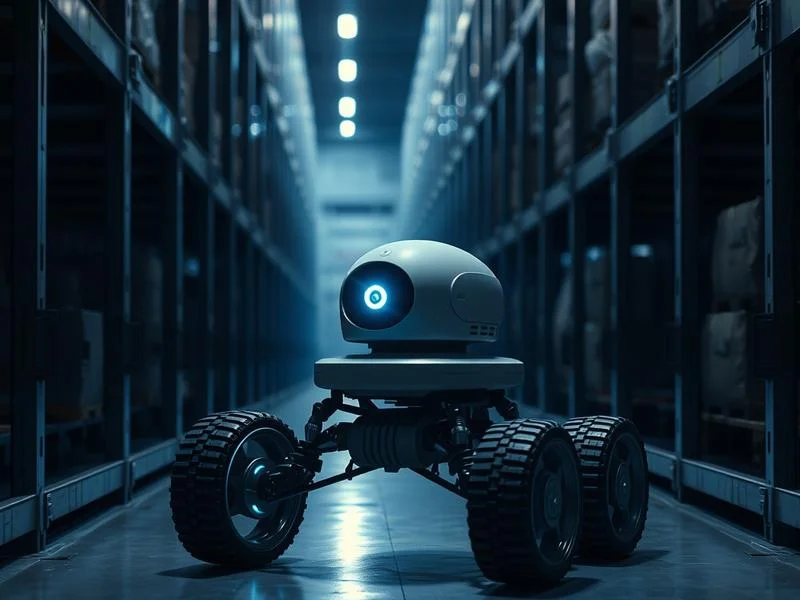
Mistral released Robostral Navigate this week: an 8-billion-parameter embodied navigation model that steers a robot through buildings it has never seen using nothing but a single RGB camera and a natural-language instruction. No lidar. No depth sensor. No pre-built map.
The pitch is simple. Give the model a camera frame and a command like “leave the lobby, walk through the corridor, enter the supply room, and stop facing the second shelf,” and it outputs either a pointing coordinate in the current view or a local displacement command. That loop, repeated, is autonomous indoor navigation on commodity hardware.
The benchmark numbers back the claim. On the unseen split of R2R-CE — the standard continuous-environment test for vision-language navigation — Robostral Navigate hits a 76.6% success rate, with 79.4% on the seen split. That beats prior single-camera systems by 9.7 percentage points. More striking: it outperforms multi-sensor approaches by 4.5 points while using neither depth nor multi-camera input. The expensive sensor stack, in other words, wasn’t buying accuracy.
The training story is where Mistral’s efficiency habits show. The model learned from roughly 400,000 trajectories across 6,000 simulated scenes — no real-world data collection fleet required. A prefix-caching scheme cut training tokens by 22x, compressing month-long runs into days. Reinforcement learning on top has already added 3.2 percentage points, and Mistral says the gains show “no measured plateau.” Expect updated checkpoints.
Because the model is hardware-agnostic, the same weights drive wheeled robots, legged platforms, and drones. Mistral is positioning it as middleware for the robotics industry: the perception-and-navigation brain that any manufacturer can drop onto their chassis. The launch comes out of the company’s newly formed AI Science Robotics division, with Airbus and BMW already signed as partners — logistics warehouses and factory floors are the obvious first deployments.
The caveats are real. Every published result is simulation-based; Mistral has shown no real-world deployment data. And the company disclosed no pricing, no release model, and no timeline — it is unclear whether Robostral Navigate will ship open-weight like much of Mistral’s catalog or stay locked behind industrial partnerships.
Still, the direction matters. Robot navigation has been gated by sensor cost for a decade: lidar units and depth rigs add thousands of dollars per unit. If an 8B model running on one webcam-class camera genuinely matches that stack, the bill of materials for useful indoor robots just collapsed. That is a bigger deal for warehouse automation than any humanoid demo this year.
Sources
Related reading
- AI Models Mistral AI Acquires Austria's Emmi AI to Build Physics-Informed Industrial Foundation Models
- AI Models Google DeepMind Ships Gemini Robotics 2, Giving Humanoids Whole-Body Control and Five-Finger Dexterity
- AI Models Anthropic's Claude Mythos Preview: The Most Capable AI Model Ever Evaluated — Locked Behind Project Glasswing